
What are warts?
Warts, also known as verruca, are common, contagious, and non-cancerous (benign) skin growths that can occur anywhere on the body and can present in a variety of ways. Warts are caused by a virus known as the human papillomavirus (HPV), which is a virus that can enter the body through injured skin or direct skin contact. HPV comes in hundreds of strains, but the most common strains found in warts are HPV 1, 2, 3, 4, 7, 10, 27, 41, 57, 60, 63, and 65. Warts can affect people of all ages, but they are mostly seen in young children and adolescents. Although most warts are typically harmless and resolve on their own over weeks to months, they can be bothersome to some people and require treatment.
Risk Factors
- Schoolchildren
- Public swimming pools/hot tubs
- People whose occupation involves working with raw meat
- History of eczema (due to skin barrier dysfunction)
- Immunosuppressed (e.g. people who have had an organ transplant, have cancer, or have HIV/AIDS)
Symptoms
For many people, warts do not cause any symptoms. They may not even realize they have warts until a physician points it out to them. However, if warts are bothersome, they usually are itchy or painful, especially if they occur on the soles of your feet.
Clinical Presentation 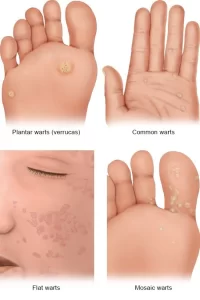
While there are many types of warts that people can develop, there are characteristic findings that differentiate them:
- Common warts – These types of warts usually occur on the hands and knees and present as rough bumps. Common warts are usually round and less than a centimeter in size.
- Plantar warts – These types of warts occur on the soles of the feet and usually present as rough and thickened skin. With a special tool called a dermatoscope, dermatologists can see small blood vessels that look like a tiny black dot to the naked eye.
- Flat warts – These warts can be found in different places on the body and present as skin-colored, slightly raised bumps.
- Genital warts – These types of warts are localized to the genital region and are associated with different strains of HPV that are not seen with the above types of warts. Genital warts are considered a type of sexually transmitted disease and are associated with an increased risk of developing an HPV-related cancer.
Treatment
Although warts are typically harmless, some people prefer to treat them due to their bothersome symptoms. However, warts pose a therapeutic challenge to many dermatologists, as they can require multiple modalities of treatment and can be unresponsive to treatment altogether.
Listed below are different options for the treatment of warts:
- Topical salicylic acid – This is the first line treatment for people who have flat warts on the face, plantar warts, and flat and common warts on the hands. Topical salicylic acid is sold over-the-counter or can be prescribed by your dermatologist and requires daily use to achieve beneficial results.
- Cryotherapy – Also known as liquid nitrogen, cryotherapy is another treatment option for flat and common warts. It can also be used to treat plantar warts in conjunction with paring the rough, thickened skin with a blade initially prior to freezing with the liquid nitrogen. Generally, the wa
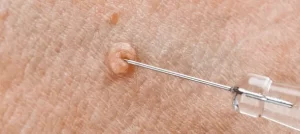 rts require 10-30 seconds of direct liquid nitrogen every 2-3 weeks until their resolution.
- Imiquimod (Aldara) – Imiquimod is a cream that acts as an immune response modifier that increases the body’s immune system to attack and treat warts. Although there are few clinical trials that have proven its efficacy, a study showed a cure rate of 88.9% in children who used Imiquimod twice daily to their warts. If you elect to use this treatment, you can expect to treat the warts for anywhere from 2 months to 1 year.
- Bleomycin injections – Bleomycin is a chemotherapeutic agent that acts to inhibit HPV DNA synthesis, therefore killing the virus. This treatment option is considered when the above treatment options fail to decrease the size of/resolve the wart. Bleomycin is injected directly into the wart every 3-4 weeks until its resolution, which can be painful for some patients. You cannot receive this treatment if you are pregnant or trying to get pregnant, as this medication can be absorbed in your body and harm the fetus.
- Candida antigen injection – Candida is a type of yeast that can be found in your mouth and on your skin in small amounts. However, when a protein associated with Candida is injected into the wart, your body recognizes the protein as a foreign object, which helps your immune system fight and clear the HPV infection. Like the Bleomycin injections, this treatment option is reserved for warts that do not respond to more conservative options, such as the topical salicylic acid and cryotherapy. The most common side effects with this injection are itching at the injection site and potentially developing flu-like symptoms for 24 hours or less.
- Pulsed dye laser – This special type of laser targets hemoglobin, which is a component of your red blood cells. By targeting the hemoglobin in the blood vessels within the wart, the laser heats up the hemoglobin and causes destruction of the blood vessels, causing the blood supply to be cut off from the wart. The average amount of treatments is 2-3 treatments for resolution of the wart. You can expect the wart to eventually slough off after the laser treatment.
Prevention
Although there is not a foolproof way to prevent warts from forming, you can take some measures to decrease your chances of developing warts:
- Cover the individual warts when in a communal space, such as a swimming pool or shared shower
- Avoid sharing clothing, such as gloves, shoes, and towels if you have a wart or know the other person has warts
- Wear sandals when at the pool or in a communal shower
- Wash your hands after touching a wart
- Do not pick or scratch the warts, which can cause the HPV to spread
Common Questions
Am I more at risk for developing cancer if I have warts?
No, you are not more at risk for developing an HPV-related cancer, such as cervical, anogenital, and oral/throat cancers. However, genital warts are associated with an increased risk for developing these cancers because they typically are caused by a different strain of HPV that are not seen with the warts that you develop on your skin. It is recommended in childhood to receive the Gardasil 9 HPV vaccine, as this can prevent up to 90% of cancers and infections caused by HPV, as well as genital warts.
Do I have to treat my wart(s)?
No, you do not have to treat your wart if it isn’t bothering you. However, if it becomes more bothersome or they are developing on multiple areas of your body, you may decide that treatment is the best option for you.
Does the HPV vaccine prevent me from getting warts?
The HPV vaccine can protect you from the HPV strains that cause genital warts and that can potentially cause HPV-related cancers. However, the vaccine does not protect against all of the strains of HPV that cause common, plantar, and flat warts. Nonetheless, you should still receive the HPV vaccine if you have not already done so due to its significant reduction in HPV-related cancers.